Author: Lucie Sýkorová, HlidaciPes.org
The German Interior Ministry banned the self-proclaimed “German Kingdom” this week and its leaders were arrested. The group, whose supporters are classified by the authorities as so-called Reich citizens who do not recognize the current German state, was founded in 2012 in Saxony-Anhalt. The authorities are now investigating, among other things, whether the group had closer ties to the AfD party. Due to the particular importance of the case, the investigation has reportedly been taken over by the Supreme Public Prosecutor’s Office in Germany.
In recent years, the Czech public has known the town of Lutherstadt Wittenberg in Saxony-Anhalt primarily as the place where former Prime Minister and ANO movement leader Andrej Babiš earned – and in recent years, conversely, lost – millions of euros. This is because Agrofert DE and its companies, the SKW Piesteritz chemical plant and the Lieken large-scale toast bakery, are based here.
But 12 years ago, a certain Peter Fitzek also founded his “German Kingdom” here. The trained chef, who will be 60 this year, managed to win over around six thousand people to his ideology in 13 years. According to German authorities, the “German Kingdom” is currently the largest grouping in the field of so-called Reich citizens. There are said to be around 25 thousand of them in Germany.
The so-called Reich citizens movement consists of individuals and small groups who reject the legitimacy of the modern German state and insist that the German Reich continues to exist. Many believe that Germany is still under Allied occupation.
Specifically, Peter Fitzek, for example, holds the opinion that the German state has a right to the borders of 1937 – that is, across the Oder and Neisse to East Prussia. His worldview is characterized by its proximity to right-wing extremism, conspiracy theories and esotericism.
From Chef to King
Peter Fitzek is a trained chef, previously a karate instructor. In 2000, he opened an esoteric bookstore in Wittenberg and founded the “Light Center Wittenberg”.
He offered esoteric seminars here, but even then he also offered training courses on “How to Create a New State?” and “How to Become a New German Civil Servant and International Civil Servant”. The center also included a small publishing house that published Fitzke’s own publications, among others, and a shop that sold esoteric products.
Fitzek later tried to succeed in politics. In 2008, he ran for mayor of Wittenberg and a year later as a direct candidate for the Bundestag in the Dessau-Wittenberg constituency. He received 0.7 percent of the vote in both elections. In the same year, he also founded the “New Germany” association, which later became the “German Kingdom”.
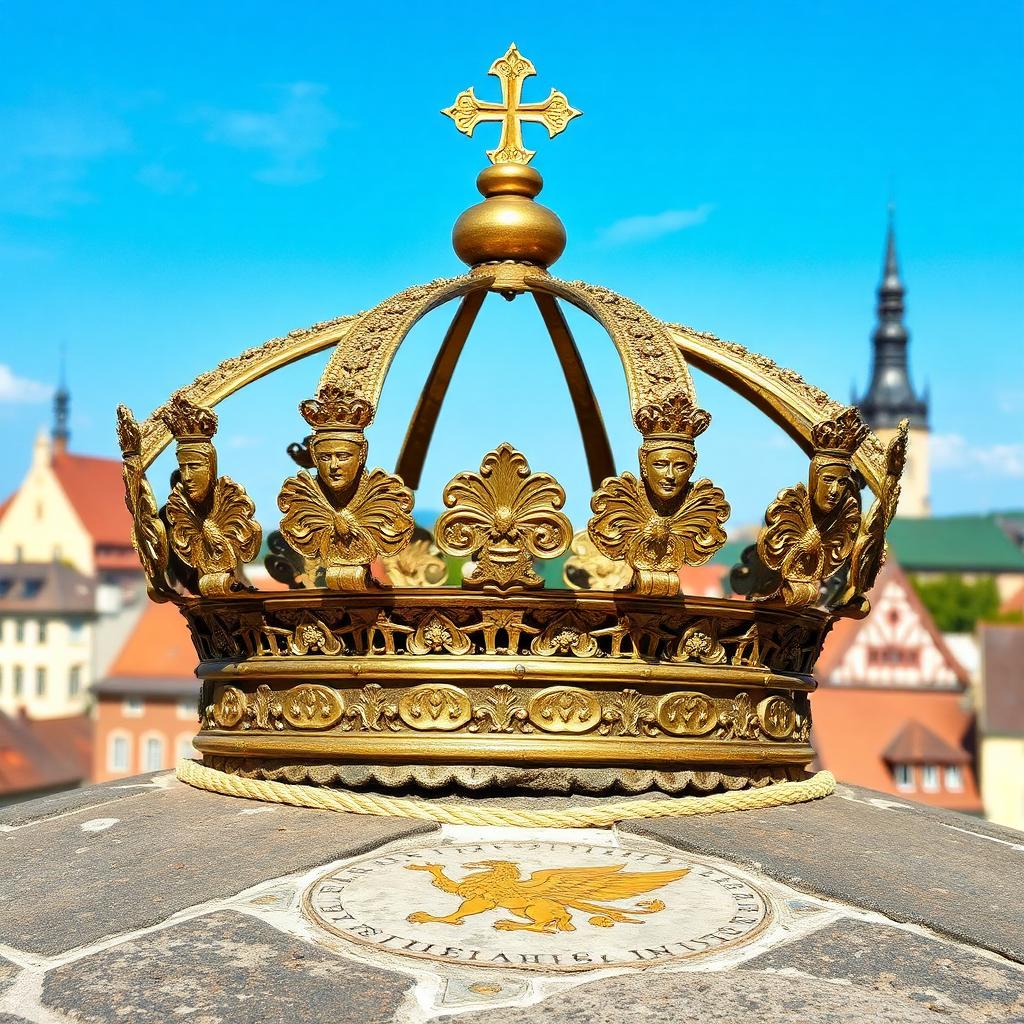
In 2012, he rented a former hospital building on the outskirts of Wittenberg, where he was crowned “King Peter I” by his followers. He promised his followers that he would free them from the German tax and social security system.
His “German Kingdom” subsequently issued its own identity cards and driver’s licenses and created its own currency, the “E-Mark” (Engelsmark, Angel Mark). Fitzek also founded his own insurance company, the “Deutsche Heilfürsorge,” which was supposed to be a health insurance company, as well as the “Royal Reichsbank,” which even had its own brick-and-mortar branch in the city center of Wittenberg.
In 2023, the financial supervisory authority Bafin closed the branch of Fitzek’s “Gemeinwohlkasse” (Social Welfare Fund) in a former bakery in Dresden. During searches of several properties, investigators found cash and gold bars worth over 360,000 euros.
The “German Kingdom” showed many signs of a sect. People sold their houses, moved to the “kingdom” residences, deposited their money in Fitzek’s bank, attended seminars on “exiting the system,” which cost thousands of euros. “Citizenship” was also paid for.
Extremist organization since 2022
Peter Fitzek has been in trouble with the law regularly over the past decade. He has been prosecuted for unauthorized banking transactions, violating the Insurance Supervision Act, and driving without a license.
His driver’s license was officially revoked in 2015; Fitzek himself handed it in to the district office in 2012, but he did not stop driving. In November 2018, he was arrested in a restaurant after he did not voluntarily start serving his sentence. He was released after three and a half months.
In September 2024, he was sentenced to eight months for insulting two Bundeswehr soldiers and pushing a security guard against the wall of the district office in Wittenberg. Fitzek appealed at the time, but the Naumburg Higher Regional Court rejected his appeal in March of this year. The arrest warrant was therefore executed on May 13, when Fitzek was arrested during house searches.
He also faces charges of “unauthorized deposits and insurance transactions,” as do three of his associates from the leadership of the “German Kingdom,” who were also arrested this week.
Fitzek’s “kingdom” was already labeled an extremist organization by the Federal Office for the Protection of the Constitution (BfV), Germany’s domestic intelligence service, in 2022. Its ban was prepared by the Federal Ministry of the Interior under former Interior Minister Nancy Faeser (SPD). The process took a long time because several federal states and authorities were involved.
The new Federal Interior Minister Alexander Dobrindt (CSU) is now speaking of a “significant blow to the so-called Reich citizens and local governments”, whose purpose and activities are contrary to criminal law and are directed against the constitutional order.
According to him, members of the “Kingdom of Germany” have created a “counter-state”, built “economic criminal structures” and undermined the “monopoly of the Federal Republic on violence”.
The authorities of the state of Saxony-Anhalt also want to investigate whether there are any links between the “Kingdom of Germany” and the AfD. As Interior Minister Tamara Zieschang (CDU) explained, evidence such as memory media and documents found in the raid in Wittenberg will be evaluated.
Peter Fitzek has previously spoken highly of the AfD in the media.
German politicians are currently debating whether to try to ban the far-right Alternative for Germany party