Author: Lucie Sýkorová, HlidaciPes.org
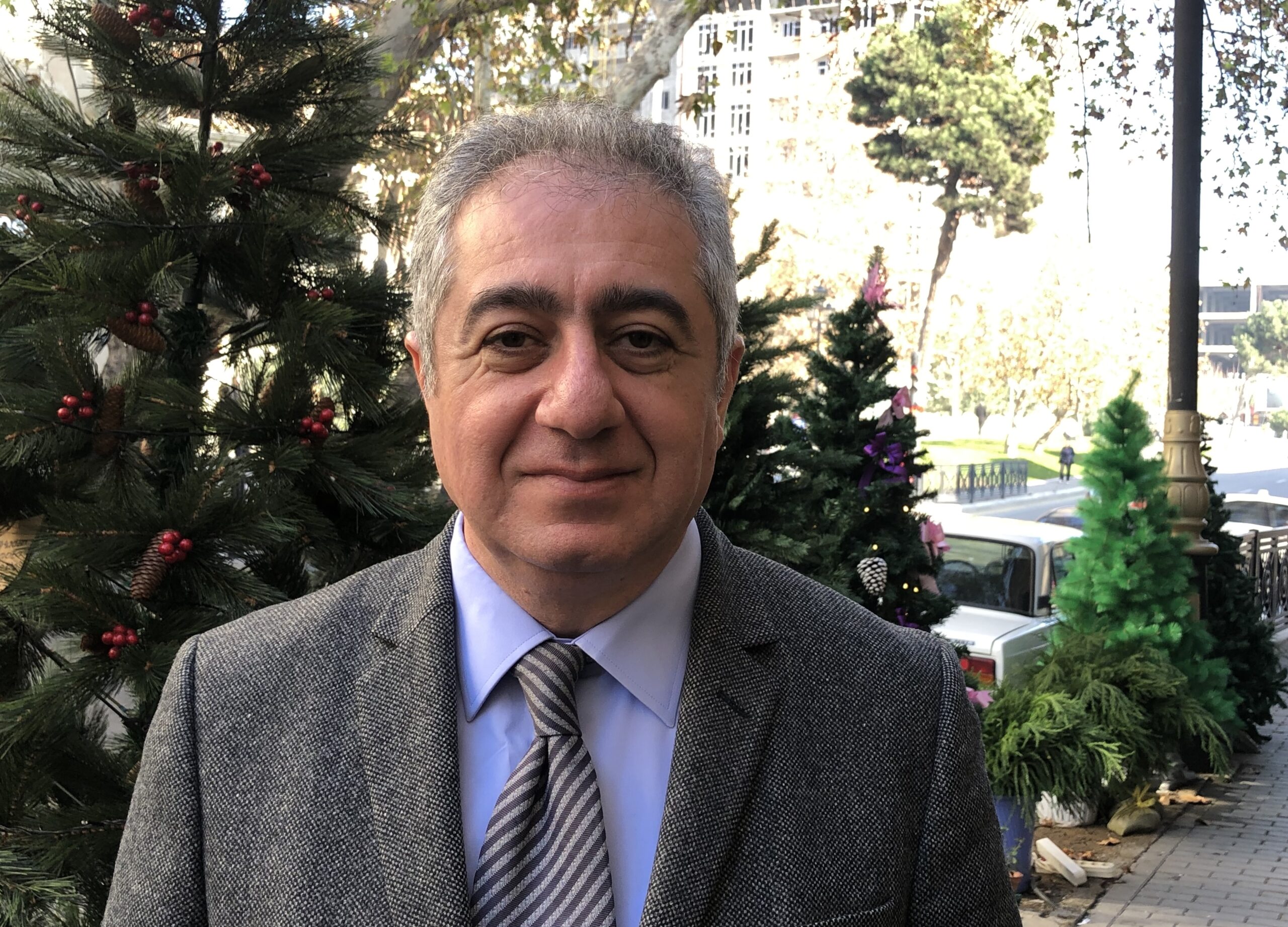
Azerbaijani economist Gubad Ibadoglu, who described corruption in the oil and gas industry and the reasons why Azerbaijan cannot meet its commitments to Europe without reselling Russian resources, is in danger of losing his life and needs urgent heart surgery. This was announced in mid-December at the European Parliament in Strasbourg by his daughter, lawyer Žala Bajramová, who represented her father at the Sakharov Prize for Freedom of Thought award ceremony. Ibadoglu was one of three finalists for the award, but was unable to attend the ceremony because the Azerbaijani regime is holding him under house arrest and did not allow him to participate online.
Gubad Ibadoglu had been living in exile in London for many years when he traveled to Azerbaijan in July 2023 to care for his sick mother. In his native country, he was ambushed and detained while driving in a staged accident, and he and his wife were brutally attacked by a group of about twenty masked men, Žala Bajramovová described.
Her mother, Ibadoglu’s wife, suffered serious injuries in the incident but subsequently managed to leave the country. Gubad Ibadoglu, however, was arrested and charged in a show trial with counterfeiting banknotes after police found allegedly counterfeit banknotes worth $40,000 in his abandoned apartment in Baku.
According to his daughter Žala, Ibadoglu was tortured in prison and his health deteriorated significantly.
“My father tried to show the world that Azerbaijan is not an ally of the European Union, but of Russia. It resells Russian gas and oil, which are supplied to Europe as Azerbaijani products. That is why the regime wants to silence him,” Bajramova said in Strasbourg.
“Azerbaijan does not currently produce enough gas and does not have enough oil to meet its obligations under agreements with the EU. According to my father’s research, Azerbaijan is even reducing oil production and will likely end it within the next decade. The reason my father believes that the oil flowing to Europe via Azerbaijan comes from Russia is the capacity of the pipeline. Only the pipeline from Russia has sufficient capacity for the supplies that Azerbaijan sells to EU countries; pipelines from other countries neighboring Azerbaijan do not have such capacity,” she explained.
Gubad Ibadoglu was released from custody in April this year and transferred to house arrest, but he is still not allowed to leave Baku. After being transferred to house arrest, he underwent a medical examination which revealed that during his time in custody, his aortic root had expanded to 5.2 cm, meaning that he urgently needs heart surgery.
According to Bajramová, the Czech Republic in particular can play an important role in putting pressure on the Azerbaijani government to release her father, or at least to provide him with the necessary medical care.
Azerbaijan is currently the third largest supplier of oil to the Czech Republic. Between January and October this year, almost 2.2 million tons of oil worth CZK 33.3 billion flowed from Azerbaijan to the Czech Republic. Last year, during the same period, it was 1.6 million tons of oil worth CZK 23.9 billion.
Gas also flows from Azerbaijan to the Czech Republic.
It won’t work without Russian gas
Gubada Ibadoglu was nominated for the Sakharov Prize by the Greens/European Free Alliance group in the European Parliament on the basis of an intervention by Czech MEP Markéta Gregorová.
“The European Parliament is very critical of the Commission’s agreements with Azerbaijan on gas and oil. Thanks to Gubad Ibadoglu, we know that some of the oil supplied by Azerbaijan to Europe comes from Russia. Otherwise, Azerbaijan would not be able to meet the quotas it has promised,” Gregorová told HlidacíPes.org.
Azerbaijani oil currently covers around five percent of the European Union’s needs. In the case of gas, the figure is around seven percent.
In July 2022, European Commission President Ursula von der Leyen signed a memorandum of understanding in Baku, which envisages Azerbaijan doubling its gas supplies to the European Union.
By 2027, at least 20 billion cubic meters of gas should be flowing from Azerbaijan to the EU annually.
In his study, Gubad Ibadoglu described why Azerbaijan will not be able to meet these commitments from its own resources.
“Current trends indicate that domestic consumption will reach 14 billion m³ in 2023 and approximately 15 billion m³ in 2026 (…) Given that Azerbaijan is unlikely to see a significant increase in production before the end of the current decade, it needs more time to be able to export 20 billion m³ to Europe. Plans to increase gas supplies to Europe are likely to be threatened by Azerbaijan’s growing domestic demand (additional gas for industrial needs and gasification of residential areas) and slow gas production. The only viable way for the country to meet its commitments to Europe by 2027 would therefore be to purchase additional gas from Russia and Turkmenistan. This would be completely counterproductive given the political rationale behind the EU-Azerbaijan energy memorandum,” wrote Ibadoglu in the conclusion of his study entitled “Assessment of the potential for cooperation between the EU and Azerbaijan in the field of energy and its impact on the EU’s dependence on Russian gas,” which he prepared in 2023 as a visiting professor at the London School of Economics and Political Science.
MEPs call on the Commission to review the agreement
In September 2023, the European Parliament adopted a resolution calling on the Azerbaijani authorities to release all political prisoners and demanding that sanctions be imposed on Azerbaijani officials who have committed serious human rights violations.
In April this year, MEPs adopted a resolution calling on the Azerbaijani authorities to drop all charges against Qubad Ibadoglu and allow him to undergo medical treatment abroad.
At the same time, they called on the European Commission to consider suspending the strategic partnership with Azerbaijan in the field of energy and to insist that any future partnership agreement must be conditional on the release of all political prisoners and an improvement in the overall human rights situation in the country.
At its last plenary session in December this year, the European Parliament adopted another resolution calling for the immediate release of all political prisoners in Azerbaijan, including Gubad Ibadoglu by name, and calling on Azerbaijan to end repression and repeal legislation restricting the activities of independent media and non-governmental organizations.
The United States is also exerting pressure. In September 2023, the US State Department issued a statement calling on the Azerbaijani government to immediately release Gubad Ibadoglu.
In February 2024, a resolution was introduced in the US House of Representatives calling for the immediate release and condemning the detention of Dr. Gubad Ibadoglu, and the following month a similar resolution was introduced in the Senate.
To date, the Azerbaijani Ministry of Foreign Affairs has only published a response to the April resolution of the European Parliament on its website.
“The resolution adopted by the European Parliament on April 25, 2024, is unfounded and openly distorts the human rights situation in Azerbaijan. The adoption of such one-sided and biased resolutions has long become commonplace for the European Parliament. This can only be seen as an explicit political order from those forces in Europe that are seeking to further worsen relations with Azerbaijan. (…) We once again call on the European Parliament to stop interfering in Azerbaijan’s internal affairs and judicial processes,” the ministry quotes its spokesman Aykhan Hajizad as saying.
Pensions of parents of accused also frozen
The case of Gubad Ibadoglu is now frozen, the family does not know the date of the trial and has no court decision, Žala Bajramová told HlídacíPes.org.
“My father is in poor health, he is under police supervision and is not allowed to travel abroad. At the same time, he currently has no source of income. We tried to sell our house, but that is not possible. So my father had to take out a loan from the bank to cover his basic living expenses.”
According to Bajramova, there are currently around 340 political prisoners in Azerbaijan, most of whom are journalists, researchers, and activists.
“According to estimates, more than 500 other people are not allowed to leave the country. The number of fabricated charges of financial crimes is growing, and in such cases, the state freezes the pensions of the parents of the accused, for example. Independent media are blocked and can only operate on social networks, but they are not allowed to receive any income from abroad. Human rights activists living in exile, including our family, regularly receive death threats. Despite all this, Azerbaijan is not yet perceived as a hostile country,” Bajramová notes.
Azerbaijani President Ilham Aliyev has been in power since 2003. Before him, the country was ruled by his father, Heydar Aliyev, who was a prominent member of the Communist Party even before the collapse of the USSR.
In February 2024, Ilham Aliyev won the presidential election again, which the opposition boycotted and called rigged.
The OSCE has also long criticized elections in Azerbaijan, repeatedly declaring them to be non-transparent and undemocratic. Human rights organizations have long drawn attention to human rights violations, the persecution of Azerbaijani dissidents, and restrictions on freedom of expression.