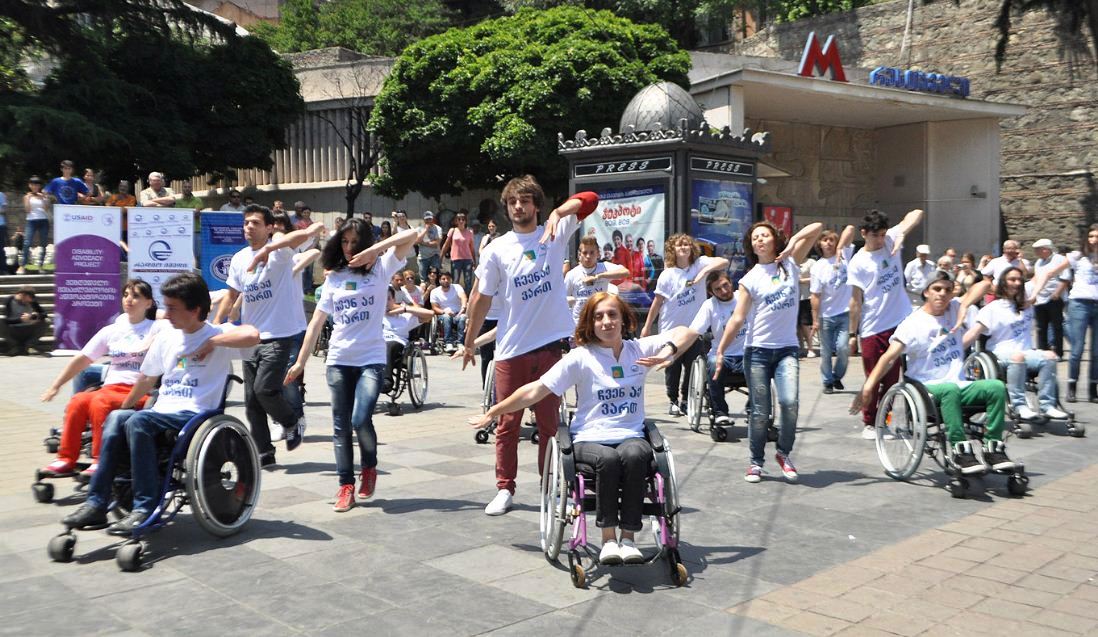
In Tbilisi, public transportation remains largely inaccessible for wheelchair users. Even the new buses introduced by City Hall, though technically adapted for people with disabilities, do not fully meet their needs. The situation is even more problematic when it comes to using the metro.
Years ago, the NGO Urban Laboratory submitted a proposal to the Tbilisi Transport Department suggesting the installation of wheelchair platforms in metro stations. During the renovation of Gotsiridze station, accessibility issues for persons with disabilities were finally partially addressed.
In principle, every new building—whether residential, hotel or any other type of infrastructure—should be constructed with the requirements of people with disabilities in mind. Newly rehabilitated parks and many tourist attractions nationwide are now designed accordingly.
In 2020, Georgia adopted Government Resolution #732, which established national accessibility standards. This means that no building or infrastructure (excluding individual private homes) can be constructed without accommodating people of all physical abilities.
Furthermore, fines are imposed for failing to design or adapt spaces and architectural elements for people with disabilities.
How Does the Wheelchair Platform Work? Are There Alternatives?
According to Giga Sofromadze, Executive Secretary of the City Hall Council for Disability Issues, an agreement has been reached for an NGO to install one or two wheelchair platforms in several metro stations as a test—Rustaveli, Liberty Square and Marjanishvili are among the proposed locations.
If successful, the Transport Department may consider patenting the solution for Georgia.
The platform is an independent device not connected to an escalator’s mechanism:
“A person in a wheelchair stands on the platform and is fastened with belts. Support staff bring the device to the escalator. When the escalator reaches a 30-degree incline, the platform stabilizes itself with special support legs… The wheelchair remains in a horizontal position throughout the ride. After reaching the upper level, support staff assist the person onto the metro platform,”
— Sofromadze told Fortuna.
He added that, given that the metro was originally built without any accessibility planning, this platform is currently the most feasible solution for Tbilisi.
What Do Wheelchair Users Say?
Ana Goguadze, who uses a wheelchair, believes the safest and most comfortable solution would be installing elevators across all metro stations:
“City Hall told us they cannot install elevators in metro stations; everything else is absurd. If the goal is to support our independence, then why should we need constant assistance?”
— she told Fortuna.
She added that instead of “inventing new bicycles,” the city should first fix existing and realistic solutions:
“They should fix the buses, many of which don’t cover all streets and whose stops are not properly arranged. Even the new buses are uncomfortable for us. The ramps do not unfold automatically.
Imagine winter: it’s icy, the driver must get out, unfold the ramp, wait for you to board, and hold up traffic… This is not normal. Some people will truly tell you, ‘Just stay home, what are you even doing outside?’”
Ana also pointed out weight limitations: the platform being tested can support only 200 kilograms:
“Some powered wheelchairs alone can weigh more than 100 kilograms. What are they going to do — put us on a scale at the metro entrance?”
She also stressed that before adapting public transport, the city streets leading to it must become accessible:
“If sidewalks are blocked by parked cars and pedestrians barely squeeze through, how is a wheelchair supposed to get by?”
Challenges on the Streets
“Fortuna” also spoke with Eka Laliashvili, Chair of the Georgian Alliance for Safe Roads:
“For wheelchair users, navigating the streets is a serious challenge. Not every district is the same. For example, the newly renovated Chavchavadze Avenue has good infrastructure, including for people with disabilities. Drivers may not like the changes, but from a pedestrian viewpoint, it is a strong model.
The problem is that in many other cities, regions, and older parts of Tbilisi, adapted infrastructure is lacking. Underpasses are a clear example — they are simply unusable for wheelchair users.
Yes, we have challenges, but it is important to note that roads currently under construction are being designed with accessibility in mind.”
Improving Road Environments for People with Disabilities — International Practices
Across almost all major European cities, metro systems include elevators for wheelchair access. Some systems also have escalators specifically adapted for wheelchairs. These elevators and escalators are also used by parents with infants in strollers.
Buses in many European cities are fully adapted — and crucially, the streets themselves are accessible.
The European Union has 101 million adults with some form of disability — more than a quarter of its population. Only half of persons with disabilities are employed. (According to WHO, around 15% of the world’s population has some form of disability.)
While everyday accessibility is primarily the responsibility of national governments, the EU also actively works in this direction. Several EU directives aim to ensure accessibility to transport, employment, products and services — especially digital services.
International and National Disability Rights Days
- 3 December — International Day of Persons with Disabilities
Established by the UN in 1992 to highlight the centuries-long discrimination experienced by people with disabilities. - 14 June — National Day for the Protection of the Rights of Persons with Disabilities in Georgia.