Author: Vojtěch Berger, HlidaciPes.org
Two recent documentary movies reveal the true nature of Viktor Orbán’s regime. Following the film „Dynasty“, which maps the origins of Orbán’s family wealth, the film „10 Years of Hatred“ is also freely available online. It is even more relevant for the Czech Republic this year before the October elections, as it shows where the targeted, long-term society dividing and the artificial creation of external enemies leads. The Czech former PM Andrej Babiš, who considers Orbán a friend, is supposed to win the election, according to the polls.
„This is being done by the same police officers who can stop you in half an hour during a routine traffic check,” says an employee of the Hungarian Helsinki Committee, describing the brutal violence of police officers at Hungary’s heavily guarded borders in recent years.
This is not new information; these missteps by Hungarian border guards are well documented, and some of them have even ended up before the European Court of Human Rights in Strasbourg.
Similarly, the public has long been aware of the inhumane conditions in the former Hungarian so-called transit zones for migrants or the brutal „push-backs“, i.e., the forced and often violent return of refugees from the Hungarian border back to neighboring countries. Ten years after the migration wave, which became a Europe-wide issue at the time, much of this has been forgotten.
State-sponsored hatred
In Hungary, as shown in a film by the popular Hungarian internet media outlet Partizán, 2015 was a particularly game-changing year. Viktor Orbán’s government tested for the first time how effective state-sponsored and state-funded hate speech could be.
Based on a government decision, refugees became enemy number one, and the pro-government media helped Orbán’s Fidesz politicians spread the story of Hungary as the last bastion defending Europe and of refugees as an unconditional risk to the security and prosperity of Hungarians, who were still recovering from the 2008 economic crisis.
There is one visual moment in the film that illustrates this very eloquently: An archive shot of hungarian guards hermetically sealing southern borders and filling the last remaining gap on the railway tracks with a railway carriage wrapped in razor wire in front of television cameras.
The border fence became a symbol of Hungary’s stance on migration at the time. The new film does not attribute this idea to Viktor Orbán, but to László Toroczkai, then mayor of one of Hungary’s border towns.
Toroczkai now leads the far-right party Mi Hazánk (Our Homeland) and last year made headlines for his statements that if Ukraine falls in the war with Russia, the Hungarians will seize Transcarpathia for themselves.
From the Czech perspective, it is worth mentioning that Toroczkai’s party has had a cooperation agreement with Tomio Okamura’s Czech right-wing xenophobe SPD movement since 2023. Despite this, Okamura’s supporters claim that Viktor Orbán’s party Fidesz remains their priority partner in Hungary.
Maximizing demonization
Orbán used the migration crisis as an opportunity to declare a state of emergency, which was extended many times since then, and Hungary spent most of the past decade in it, under other pretexts such as the COVID-19 pandemic and, most recently, the war in Ukraine.
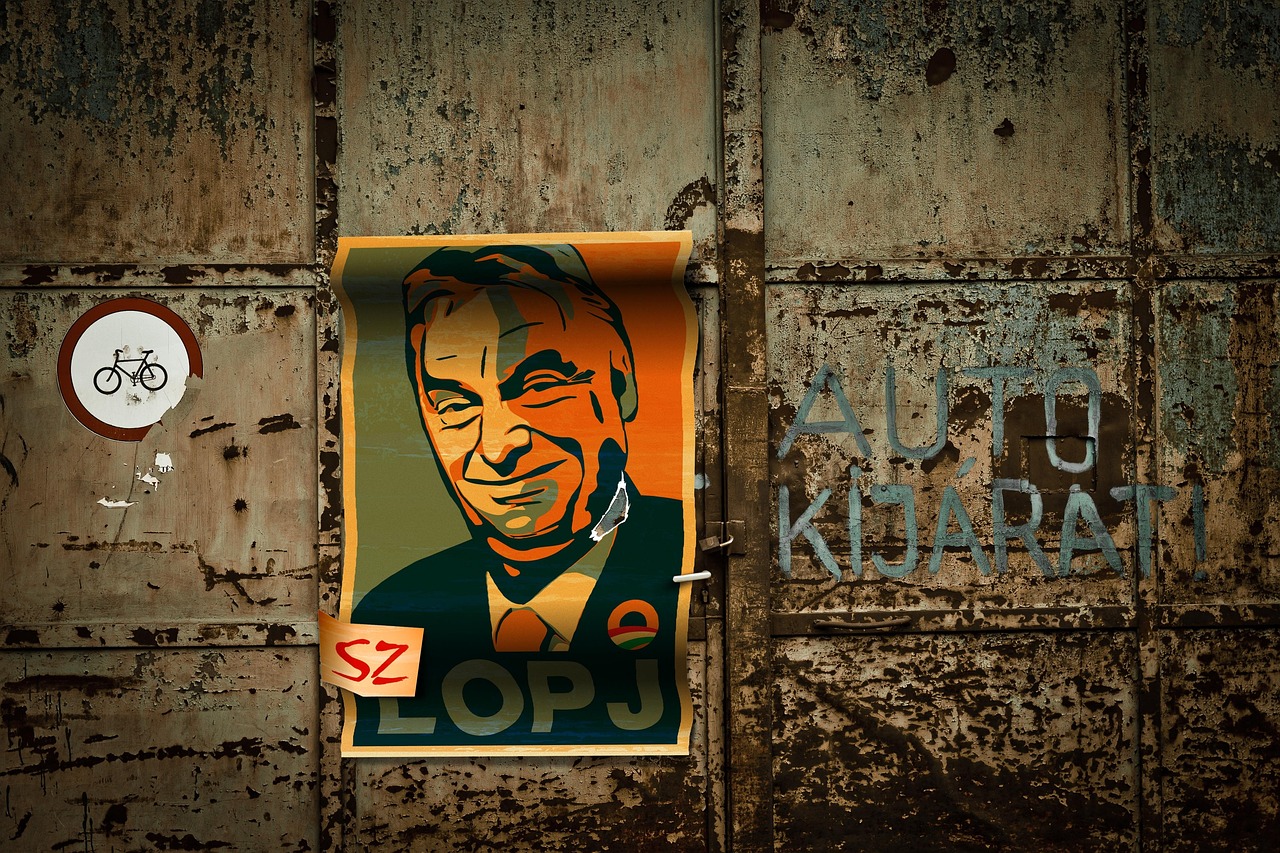
Spreading fear of refugees worked – Fidesz’s popularity began to rise again after a period of decline, and it was time to turn up the heat. George Soros, a financier of Hungarian origin, appeared on the scene, or rather on government billboards and posters, whom Viktor Orbán (although once a recipient of Soros’s study scholarship himself) turned into a new arch-enemy of the state with the help of state funds and the media machine.
The filmmakers point out that this strategy comes from former Republican advisor Arthur Finkelstein, who was in contact with Fidesz years ago and, like no one else, was able to „maximize demonization“.
Soros was labeled as someone who wants to flood Europe and Hungary with migrants. On government billboards, he was stylized as an old man mocking the Hungarian public.
Gradually, the topic of non-profit organizations and the fight against gender ideology was added to this. In 2022, after Russia’s invasion of Ukraine, the range of topics deliberately polarizing and dividing Hungarian society was expanded to include the topic of „peace“.
Trapped by politics of fear
Through the comments of experts in the documentary, the filmmakers conclude that Hungarian society has been severely affected by this decade-long targeted hate campaign. This is manifested, for example, in the brutality of police officers at the border, online and physical attacks on representatives of non-profit organizations and other social groups, and the vanishing of an open public debate.
„The main responsibility lies, of course, with the government, which invented it and has maintained it for more than ten years. But we are also responsible because we support it. Sometimes quietly, sometimes loudly,” says one of the respondents.
What does all this mean for the Czech Republic? Given the proximity of part of the Czech political spectrum to Viktor Orbán, quite a lot.
Some of the Czech domestic political campaigns in recent years have resembled some of the Orbán’s campaings. For example, the posters of ANO leader Andrej Babiš in the last presidential election with the slogan „I will not drag Czechia into war“ or the black man with a bloody knife and a slogan „Imported surgeons“ from the SPD party.
Andrej Babiš personally admired the Hungarian border fence with razor wire during the 2021 election campaign and even had himself filmed standing next to it. His close associate Tünde Bartha received a high state honor from Viktor Orbán, as did the former editor-in-chief of Lidové noviny newspaper (which at the time still belonged to Babiš’s holding Agrofert) István Léko. Babiš himself describes Orbán as a friend.
However, after ten years, the Fidesz party has fallen into a trap of its own anti-immigration hysteria, having to explain to voters why it is allowing foreign workers into the country, without whom the Hungarian labor market could not function. At the same time, Fidesz’s popularity has been lagging behind the newly founded Tisza party for some time.
After ten years of continuous government hate propaganda, Hungary is showing that this has massive negative effect on the whole society. Czech fans of Viktor Orbán cannot see that far ahead yet. Or rather don’t want to.