Author: Vojtěch Berger, HlidaciPes.org
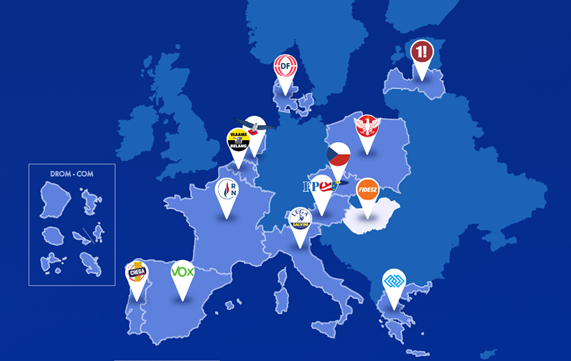
The Czech ANO party denies that its new partners in the Patriots for Europe political group in the European Parliament are pro-Russian or have ties to extremism. In reality, the opposite is true. A recent excursion to the heavily guarded southern Hungarian border, that was attended by young members of ANO at the invitation of Viktor Orbán’s Fidesz party, is a good example. They were accompanied by one of the main faces of the German magazine Compact. The magazine wants to “overthrow the system”, has previously published anti-Semitic content, and is spreading Russian propaganda.
The border fence on the Hungarian-Serbian border is a kind of pilgrimage site for Viktor Orbán’s government. Former Czech prime minister Andrej Babiš, who calls Orbán his friend, visited it twice during the election campaign – before the 2021 parliamentary elections and a year later before the presidential election, in which he also ran.
At the turn of May and June 2025, Orbán’s Fidesz party, or rather its youth wing Fidelitas, invited young people from partner parties abroad and other guests to the border fence, including representatives of Babiš’s ANO party youth wing.
“To overthrow the system”
Destroyed cars were prepared at the fence, where the participants of the excursion took photos and videos and explained to the audience on social media that the cars had been destroyed by aggressive migrants. Foreign guests received this information from the Hungarian border guards present, not only in the field at the border, but also during a lecture inside.
Adam Knedlhans, chairman of Young ANO, also filmed a similar video on site: “Our Hungarian colleagues are also defending our sovereignty and our security. Thank you for this commendable work,” were phrases that sounded like they came from a Hungarian government handbook. His words of gratitude and similar statements by other participants were then reproduced by some Hungarian pro-government media.
Among the participants in the event, which was carefully staged by the Hungarian side, was Paul Klemm from the German magazine Compact, who was there filming too.
Since 2021, Compact has been considered right-wing extremist by German counterintelligence. Two years ago, its editor-in-chief, Jürgen Elsässer, wrote that the magazine’s goal was to “overthrow the system”. The magazine also spread anti-Semitic content, published texts downplaying the Nazi regime, and, last but not least, repeated Russian propaganda.
On the Compact platform’s website, it is now possible to buy silver medals with motifs of “friendship with Russia” and others. The sale of these medals helps finance similar far-right projects in Germany and elsewhere.
Klemm participated in the event with Young ANO in Hungary at the same time when a court in Germany was about to decide on a ban on his Compact magazine – because of its extremist content.
However, according to the Czech participants of the trip to the Hungarian-Serbian border, they had no idea about any of this. “I’m hearing these names for the first time. We were only there at their (Fidesz youth wing) invitation, in our free time. I didn’t have an overview, a list of people who participated, nor did I talk to them,” says Mladé ANO leader Adam Knedlhans.
Extremists in parliament
Contacts with German extremists have so far been the domain of another Czech opposition party SPD, which cooperated with the youth organization of the Alternative for Germany party (Junge Alternative). The latter dissolved itself this spring – again due to extremist tendencies – and the AfD party plans to establish a new youth wing.
A group of SPD politicians met Junge Alternative two years ago in Ústí nad Labem city at a weekend seminar. According to available photographs, Kurt Hättasch was also present. He was arrested last fall in Germany as part of a raid against a group suspected of terrorism that was planning a Nazi-style coup in the east of the country, including ethnic cleansing.
Last September, Tomio Okamura and other SPD figures personally guided a Junge Alternative delegation through the Czech Parliament building. The photos from the event also show Benedikt Kaiser among participants from Germany, who also has a neo-Nazi past.
This year, Okamura was interviewed by the aforementioned Paul Klemm for the Compact magazine. In the half-hour interview in the Czech Parliament the magazine described Okamura as the “leader of the Czech opposition”, which does not correspond to the party’s support in the polls.
From liberals to far-right
The SPD movement has always responded evasively to questions about the extremism of its German and other foreign partners, or refused to comment at all. Mladé ANO has taken a similar stance on the issue so far.
“I met these people at the border fence trip. There was no time for any deep acquaintance, it was a formal meeting with other young politicians,” adds Knedlhans, noting that this was the first foreign trip within the framework of this cooperation.
A year ago, the ANO youth organization and the party’s think tank, the Institute for Politics and Society, simultaneously left the European liberal structures to which Babiš’s movement had belonged until then and reoriented themselves toward new partners within Patriots for Europe.
As the ANO movement, including its youth wing, becomes more firmly entrenched in the community of Fidesz, the Austrian Freedom Party, and other partner parties, similar interactions with their extremist wings are likely to increase.